What Does a Building Envelope Defect Really Cost? A 5-Year View
For owners and facility managers evaluating repair estimates, the real question isn't the invoice in front of you — it's what delay adds to the bill.

That small crack along the window frame. The discoloured patch near the roofline. The sealant joint that's pulling away from the concrete. These envelope issues look minor — until the repair estimate arrives and the number seems far bigger than the visible damage.
Here's why: water and air don't respect boundaries. A single point of entry can lead to saturated insulation, damaged interior finishes, and secondary deterioration that spreads well beyond the original defect. What appeared to be a simple reseal becomes a multi-trade restoration project.
For owners and facility managers working within tight budgets, the real question isn't "How much does the repair cost?" It's "What does delay add to the bill?"
This article looks at three cost horizons — cost now, cost over five years, and cost if deferred — and closes with a practical framework you can apply the next time an envelope defect lands on your desk.
Why envelope defects get expensive
Envelope defects don't just create visible repair work — they create hidden damage. That's the real cost driver.
Water intrusion is the recurring theme in almost every building envelope failure. Once moisture finds a path inside, it can saturate insulation, damage interior finishes, promote mould growth, and trigger deterioration in structural elements. The longer it goes unaddressed, the further it spreads.
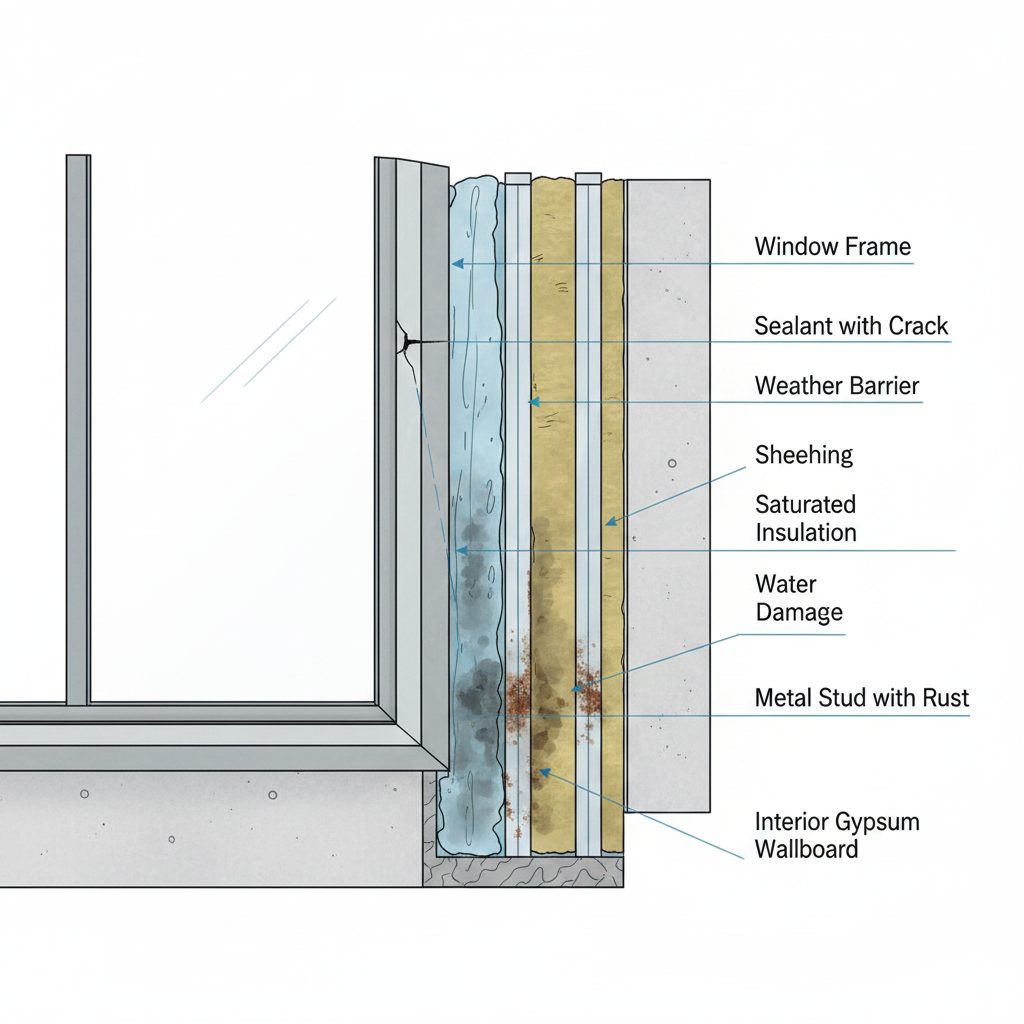
Repair-only approaches often fail because they treat the symptom without identifying the true cause. A contractor reseals the visible joint, the leak stops temporarily, and six months later the staining returns — because the actual failure path was somewhere else entirely. Each round of patching adds labour and material costs without solving the underlying problem.
And when envelope failures lead to litigation or insurance claims, the financial exposure expands dramatically. Claims can include remediation costs, lost rental revenue during repairs, diminished property value, and legal fees. What started as a maintenance item becomes a capital event.
What "cost now" includes
The immediate cost of addressing a defect is broader than the contractor invoice. Before comparing repair options, make sure you're capturing the full picture:
- Inspection and diagnostics: visual assessment, moisture testing, thermography, or probe openings to understand the extent of the issue.
- Localized repair: sealant replacement, flashing corrections, membrane patching, or substrate repair.
- Access costs: swing staging, boom lifts, scaffolding, or interior protection — often a significant line item on mid-rise and high-rise buildings.
- Temporary protection: if the defect is active, emergency tarping or expedited response may be needed before permanent repairs can be scheduled.
- Interior patching: drywall repair, paint, flooring, or ceiling tile replacement if moisture has already reached occupied spaces.
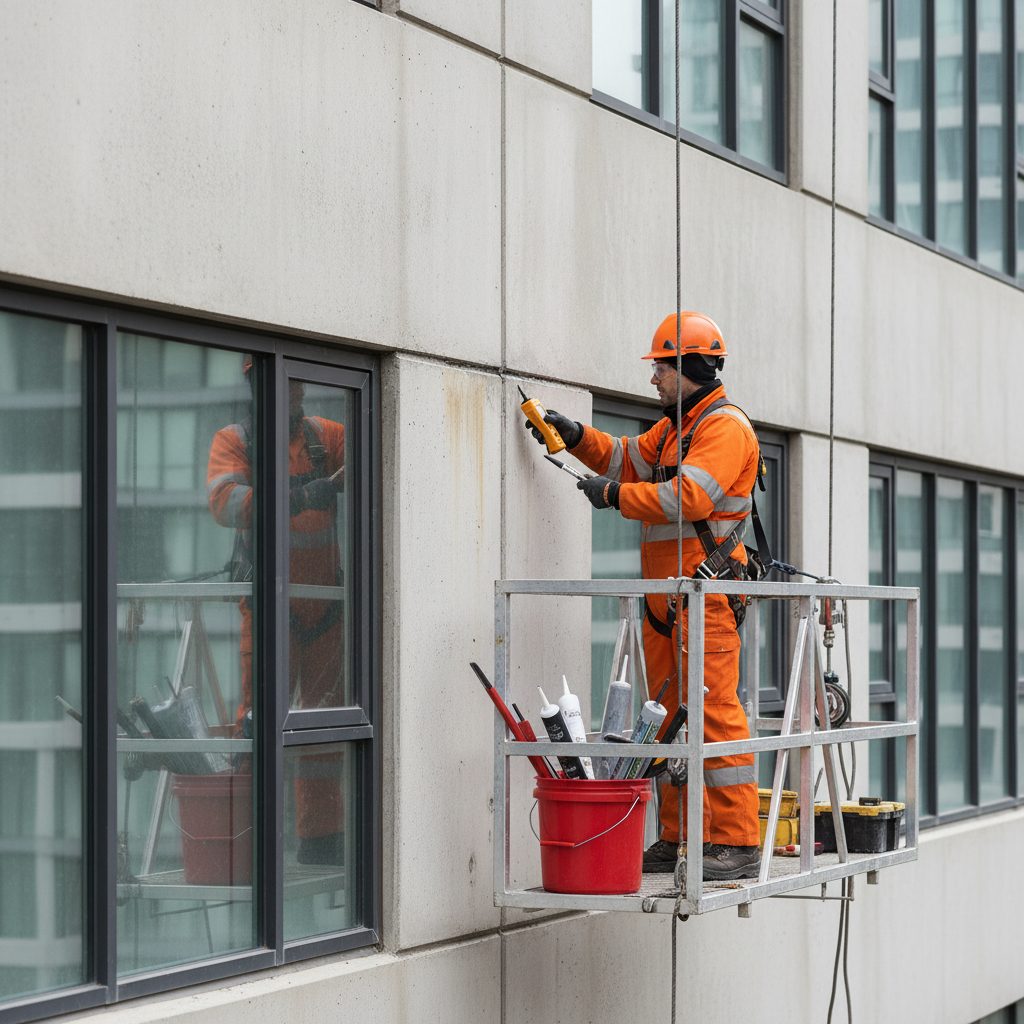
Regular inspection of roofs, walls, windows, and foundations is the most cost-effective way to catch issues before they escalate. The "cost now" for a defect caught early is almost always lower than for one discovered after water has been entering for months.
What "cost over 5 years" includes
The five-year view is the most useful planning horizon for envelope decisions. It's long enough to capture recurrence patterns and slow deterioration, but short enough to fit within capital planning cycles. Here's what to factor in:
- Repeat patching: if the root cause isn't addressed, you may pay for the same repair multiple times. Year-one patching looks inexpensive in isolation — until you add years two through five.
- Energy losses: air leakage through failed seals and moisture-related insulation decline raise heating and cooling costs incrementally over time. These losses are easy to ignore because they don't arrive as invoices, but they're real operating expenses.
- Escalating scope: a defect that starts at one window unit may spread to adjacent units if the underlying detail is repeated across the facade. What begins as a single repair can become a phased remediation program.
Framing envelope decisions as lifecycle choices — not one-time repairs — is essential for accurate budgeting.
What "cost if deferred" includes
Deferring repairs often converts a manageable defect into a much broader remediation project. Here's how the numbers can escalate:
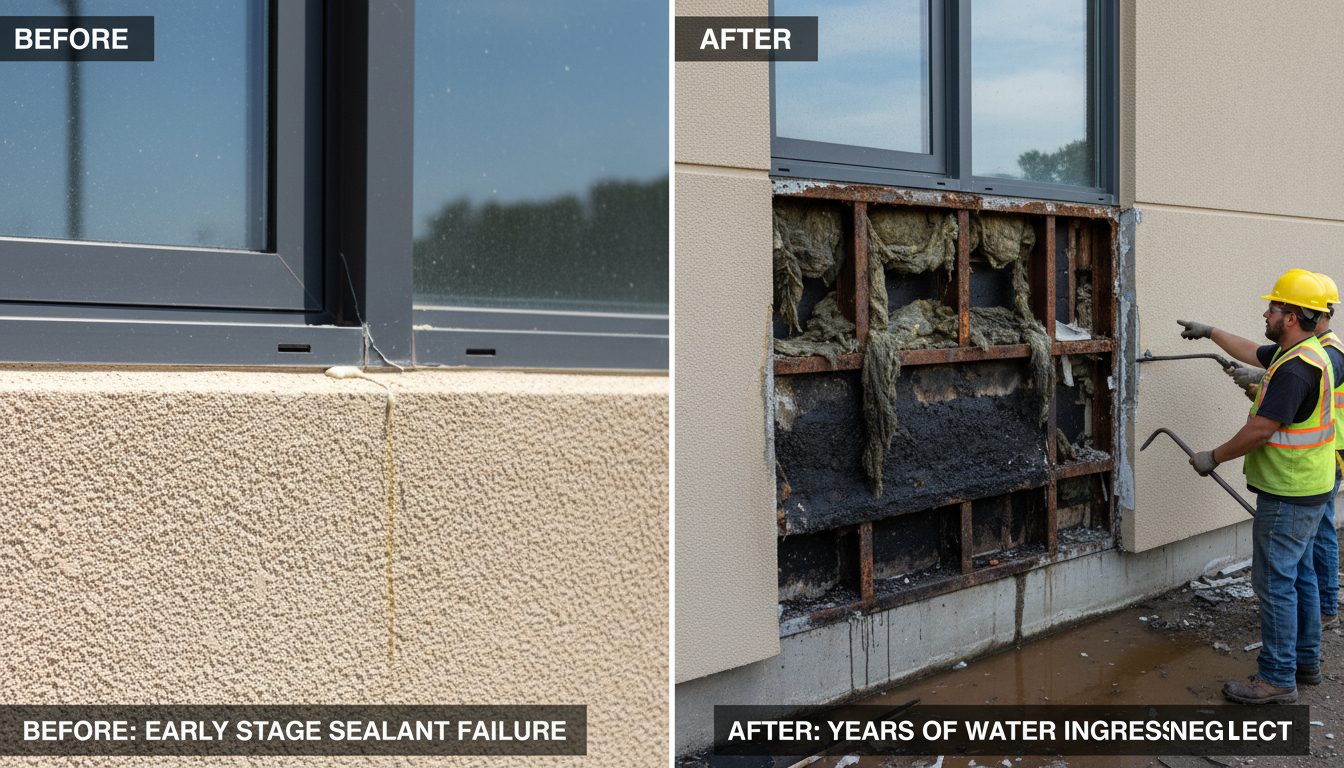
- Secondary damage: small leaks that go unaddressed can saturate insulation, rust structural connections, rot wood framing, and damage interior finishes. Remediation then requires multiple trades and potentially structural repair.
- Expanded scope: once damage becomes systemic — affecting multiple floors, units, or facade areas — the budget moves from localized repair into large capital planning. A $15,000 repair can become a $500,000 restoration.
- Business interruption: tenants may need to be relocated during major envelope work. Lost rental revenue, temporary accommodation costs, and lease complications add up quickly.
- Insurance and legal exposure: if deferred maintenance contributes to a failure that harms occupants or triggers a claim, coverage disputes, liability issues, and litigation costs can dwarf the original repair estimate.
A simple decision framework
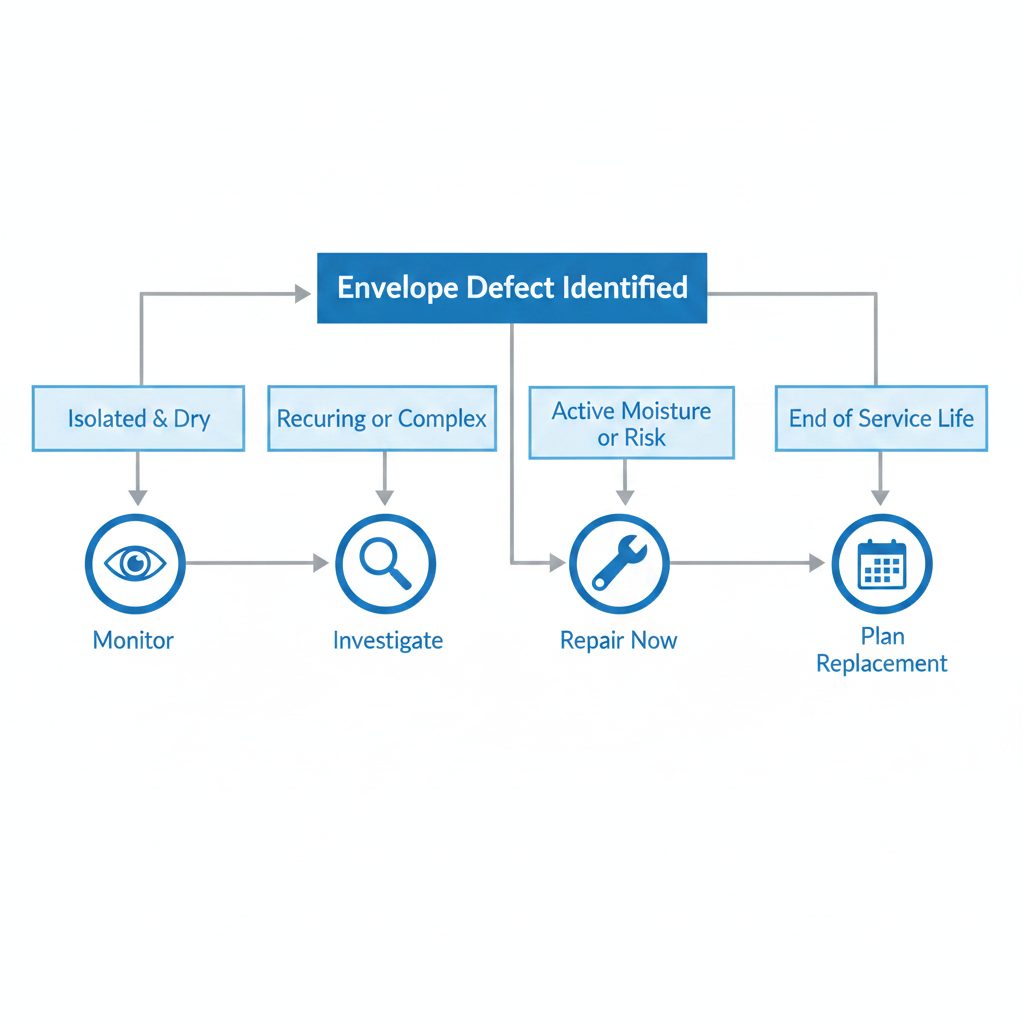
Not every defect requires immediate action — but every defect requires a decision.
Monitor
If the defect is isolated, currently dry, and not located at a high-risk detail (transition, penetration, or window interface), scheduled monitoring plus routine maintenance may be appropriate. Document the condition and set a review interval.
Investigate further
If the issue is recurring, previous repairs have failed, or it's tied to a complex detail, invest in diagnostics before committing to another repair. Probe openings, moisture testing, or a forensic review can identify the true failure path.
Repair now
If there's visible moisture entry, recurring staining, mould risk, or evidence that multiple envelope systems are aging together, deferred action almost always increases total cost. The math favours early intervention.
Plan for replacement
If the defect is symptomatic of a system that's reached the end of its service life — aging windows, deteriorated cladding, a roof approaching 25 years — patching may not be cost-effective. Build the replacement into your capital plan.
Example: a window perimeter leak
A failed sealant joint at a window perimeter on the fifth floor of a mid-rise office building — a scenario most owners will recognize. The figures below are illustrative, not a quote.
Path A: Immediate repair
- Access (swing stage)$1,500
- Reseal, inspect, water test$2,500
- Interior touch-up$500
- Years 2–5 (monitoring)Minimal
Path B: Repeat patching
- Year 1 patch (no diagnostics)$2,000
- Year 2 leak returns, re-patch$2,500
- Year 4 re-patch + interior repair$4,000
- Root causeUnresolved
Path C: Deferred action
- Years 1–3No action
- Year 4: cavity discoveredSaturated, rusted, mould
- Remediation scope$35,000+
- Tenant disruptionVariable
The numbers in your building will differ, but the pattern holds: early, root-cause-focused intervention is almost always the least expensive path.
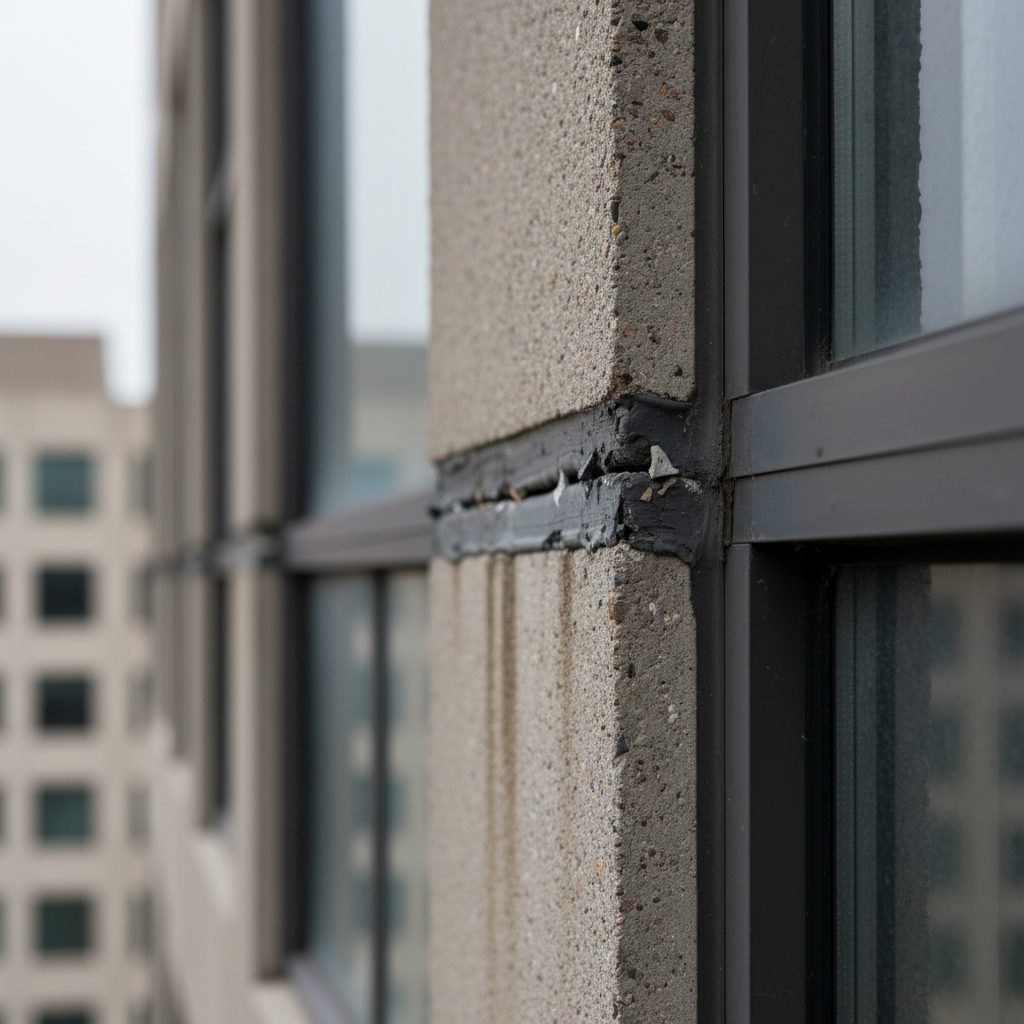
A building envelope defect is a lifecycle cost problem, not just a repair problem.
Recommendations for owners and facility managers
- Start with root-cause investigation. Before approving any repair, make sure the contractor — or your consultant — has identified the true failure point, not just the visible symptom.
- Frame decisions around lifecycle cost. Compare options over a five-year horizon, not just the current budget year.
- Use your data. Maintenance records, inspection reports, and condition assessments should feed directly into capital planning.
- Build envelope work into reserve planning. Major systems — roofing, cladding, windows — have finite service lives. Budget for their eventual replacement.
- Engage specialists for complex issues. Recurring envelope failures often benefit from forensic review by a building envelope consultant who can diagnose the underlying cause and specify a durable repair.

The bottom line
A building envelope defect should be evaluated as a lifecycle cost problem, not just a repair problem. The real expense includes immediate correction, repeat failure risk, deferred deterioration, energy loss, tenant disruption, insurance friction, and larger capital replacement if action is delayed.
For owners and facility managers, the best financial question isn't "How much does the repair cost?" It's "What does delay add to the bill?"
If you're weighing a repair estimate against the cost of waiting, contact BlueBridge Group for an independent condition assessment before you commit to a repair path.
Your roof and your solar decision are the same decision.
If your membrane is 15+ years old, you're inside the window where a combined envelope-and-solar project beats two separate ones. Grab the 10-minute guide.
Read the Decision Window Guide →Not sure what your defect really costs?
Get an independent condition assessment before you commit to a repair path — so you know what you are dealing with, and what it will really cost to fix.
Book a 20-Minute Building Review